Lessons from a 'failed' charter school
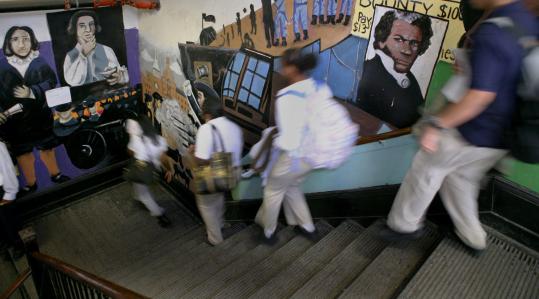
 The Uphams Corner Charter School in Boston serves grades 5 through 8, and has an enrollment of about 160 students
AT THE State House late last month, Governor Patrick outlined a plan to lift the cap on charter schools, so long as those new schools served students most at risk. They'd have to serve at least 5 percent more special-education students, students who don't speak English at home, or children from low-income families than the regular schools in the local district. People in the charter movement, when they heard the news, were ecstatic - more charters, extending their excellent programs to students who are currently underrepresented among charters.
At the Uphams Corner Charter School, though, we were dumbstruck. The same day Patrick made his announcement, the state revoked our charter. At Uphams Corner, the reaction to Patrick's plan, from our board's president to our fifth-graders, was heated but proud: A charter school that serves those kids? Great idea. Somebody get on that.
Intent doesn't count
I co-founded the school and have worked here since the day we opened. In a report provided to state officials, an evaluation panel characterized our school as an apathetic, confused, chaotic place. But the school described in the document is one that I don't recognize. We have no major discipline events, no graffiti, no noise in the hallways, a fully documented curriculum, and excellent teachers doing very good work.
We have never disagreed with valid criticisms of our school. We're not located in the area that gives us our name. And more to the point, the MCAS scores at our school have been abysmally low for years. We open the Globe with dread in September to find our school ranked among the lowest in the state. The stomach-punch is real, the almost existential gap between effort and outcome causing us, for years, to question and improve our methods.
And while this is where you might expect me to rail against the MCAS, I won't. If I had children, I'd want them to pass that test, and there's no reason why the children in my care can't do the same. They're brilliant, weird, astonishing, and (though they'd never say so) starving to learn. I agree: For schools, intent and effort don't count. So when we testified before the state Board of Elementary and Secondary Education, arguing against the revocation, there were no bleeding-heart arguments. No throngs of angry parents and students with picket signs and tears. Just a story more complex - and far more essential to filling the gaps identified by Patrick's new charter plan - than anyone beyond our walls might have imagined.
In charters across the country, there's a movement toward "paternalistic schools," a term used favorably by David Whitman of the Fordham Institute. Their argument is that "urban" students need schools with the highest levels of student compliance and routine. In some of these schools, children don't speak from the moment they get off the bus until they get back on again. Others have disobedient students wear a certain-colored shirt and order other students to "shun" them. When we were starting our school, some of these schools were saying, "We're not for everyone." These schools continue to get enormously positive attention and deep private funding.
Continued...



 Posts



